
Covered Calls in a Canadian TFSA
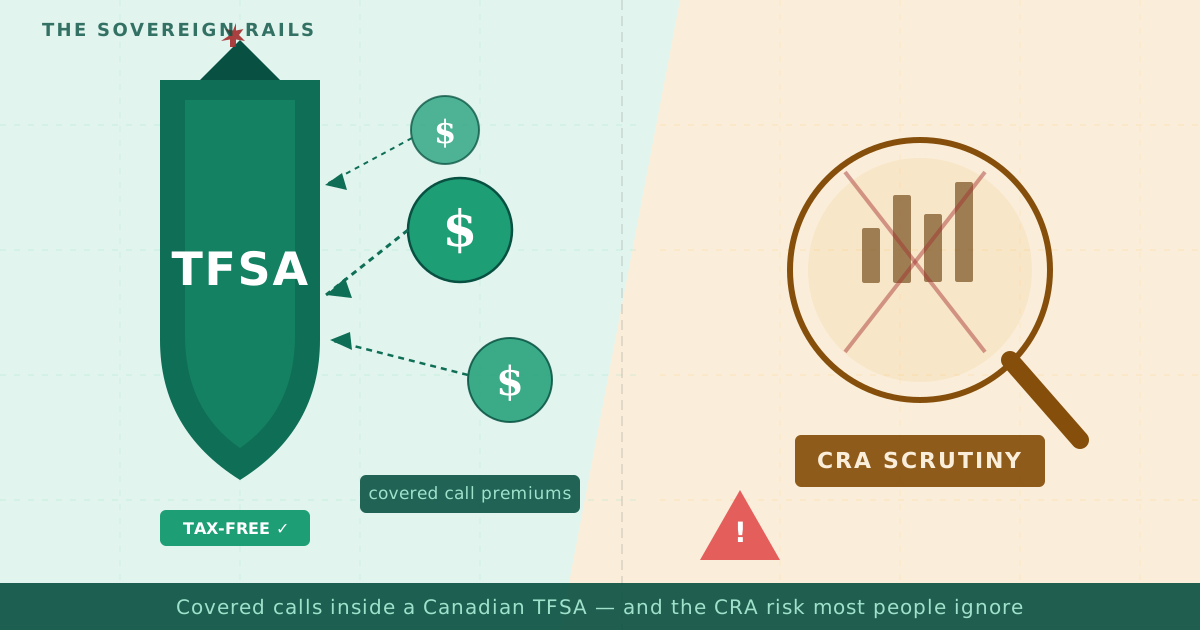
Operator's notes only — not financial or tax advice. This is a record of how I think about this question in my own accounts. Consult a qualified Canadian tax advisor before acting on anything here.
A TFSA feels like the obvious place to run a covered-call program. You write calls on shares you already own, premiums flow in tax-free, and the whole thing compounds inside the shelter. On paper it's almost too good.
I used to think the same thing. I don't anymore — and the reason matters if you're running any kind of systematic options program in a registered account.
What the CRA actually says
The CRA permits covered-call writing inside a TFSA. Options on qualified investments are themselves qualified investments, so there's no rule that says you can't do it. That part is clear.
What's less clear — and what a lot of people running covered calls in their TFSAs don't realize — is that the CRA has a separate set of rules that has nothing to do with what's inside the account. It's about what kind of activity you're running.
The rule is this: if the CRA decides your TFSA is being used to carry on a business, the account loses its tax-exempt status. Every dollar of income generated inside it becomes fully taxable — at your marginal rate, as business income — in the year it was earned. Not just the options premiums. The whole account.
The legal basis for this is section 146.2 of the Income Tax Act. The CRA has been applying it more aggressively in recent years as options trading inside TFSAs has grown. There are real reassessments out there. This isn't hypothetical.
What "carrying on a business" actually means
The CRA doesn't publish a bright-line rule that says "more than X trades per year = business income." It's a facts-and-circumstances test, and the factors they look at include:
- How often you're trading
- Whether there's a profit motive beyond long-term capital appreciation (there is, with covered calls — the whole point is to collect premium)
- Whether you have specialized knowledge or training in options
- How much time you spend on the activity
- Whether the activity is similar to what a business would do
A covered-call program hits several of these. You're writing calls systematically, with the intent to collect premium, using knowledge most people don't have. That pattern looks a lot more like a business than a passive investor holding index funds.
The CRA has been specific about this. In several technical interpretations and one well-known court case (Ahamed v. The Queen, 2023), the agency made clear that active, frequent options trading in a TFSA can result in the account being treated as carrying on a business. The Ahamed case involved day trading rather than covered calls, but the underlying principle — that the CRA will look through the account to the nature of the activity — applies equally.
Where the line sits in practice
I've talked to a Canadian CPA who works with Bitcoin-thesis investors, and the guidance I've received is consistent with what you find in the literature: the risk isn't binary, it scales with frequency and systematization.
Writing covered calls a few times a year on a long-held position, well out of the money, as part of a clear buy-and-hold strategy — that's defensible. The CRA has generally left that pattern alone. The intent is capital appreciation; the occasional premium is incidental.
Running a weekly or monthly covered-call program — automated, systematic, premium-focused — is a different pattern entirely. That's the one that looks like a business. The premium income isn't incidental to a long-term hold; it is the strategy. The CRA knows the difference.
The middle ground is where it gets complicated, and where the "depends on your facts" answer from any honest tax professional comes from.
What I decided to do
When I understood this risk clearly, I made two changes to my own setup.
The first was simple: I stopped opening new covered-call positions inside my TFSAs. The existing positions I let run to expiry. No new writes. My TFSAs hold MSTR as a long-horizon, never-called position — capital appreciation only, passive hold. That's a pattern the CRA has no reason to look at twice.
The second was more structural: I moved the active covered-call program — the systematic, premium-focused writing — into a non-registered margin account. The tax treatment in a margin account is less exciting. Premiums on expired calls are capital gains (50% inclusion), and if the CRA ever argued business income, it would mean those premiums are fully taxable rather than half-taxable. That's a meaningful difference, but it's not the same as having an entire TFSA's tax-exempt status wiped out.
The way I think about it: the margin account caps my downside on the options-income question. The TFSA is too valuable — decades of accumulated contribution room — to risk on a strategy that sits in a grey zone.
The account-location question for MSTR specifically
If you hold MSTR and you're thinking about covered calls, account location matters a lot. MSTR generates capital gains, not dividends. There's no withholding-tax argument for keeping it in an RRSP (unlike US-dividend-paying assets, where the Canada-US treaty gives you a meaningful benefit). So the RRSP argument for MSTR is mostly about tax deferral — and for Canadians near their RRIF conversion age, that argument weakens considerably.
A TFSA holds MSTR well for the core position — tax-free appreciation, no RRIF clock, no mandatory withdrawals. But if you want to write calls on it, you're back to the business-income question. The cleanest setup I've found is to split the position: TFSA for the shares you never intend to call away, margin account for the sleeve you're writing calls against. Two separate lots, two separate purposes, two separate patterns of activity.
One note on frequency, because it matters a lot: if you're writing covered calls in a non-registered margin account, keep the cadence low and document your intent. A well-documented, infrequent program is defensible as capital. A high-frequency, automated program in a margin account has its own business-income exposure — the same logic that applies in the TFSA applies there too, just with lower stakes (you're risking a worse tax rate, not the entire account's exempt status).
The FAQ the CRA won't answer directly
Can I write one covered call per year inside my TFSA without risk?
Probably, if it's on a genuinely long-held position, well out of the money, and clearly subordinate to a buy-and-hold thesis. "Probably" is the honest answer — there's no safe harbour rule.
What's the worst case if the CRA reassesses my TFSA?
The account loses tax-exempt status for the year(s) in question. All income — not just options premiums — becomes taxable as business income. Interest and penalties apply to the unpaid tax. It's a significant hit.
Does the type of covered call matter?
Yes. Deep in-the-money calls structured to be assigned look more like trading than far out-of-the-money calls structured to expire worthless. Intent matters, and the terms of the contract are evidence of intent.
What should I do before changing my setup?
Talk to a Canadian CPA who has experience with both registered accounts and active investors. The facts of your situation — how often you're writing, what you're writing on, what the rest of your account looks like — determine the actual risk level. General guidance gets you to the question. A professional gets you to the answer for your specific case.
The bottom line
A TFSA is one of the best accounts a Canadian has. The tax-free compounding on a long-term holding is genuinely hard to beat. That makes it worth protecting.
The covered-call question isn't "can I do it?" — the answer is yes, technically. The question is "does the pattern of activity I'm running look like a business to the CRA?" If the answer is anything other than a confident no, the margin account is the right place for the active program. Keep the TFSA for what it's best at: holding the thing you want to compound, untouched, for a long time.
That's the call I made. Your facts may point somewhere different — which is exactly why the CPA conversation is the right first step.
The Sovereign Rails is a monthly letter written from inside a leveraged Bitcoin-thesis portfolio on Canadian rails. If this is the kind of thinking you're looking for, subscribe here.