
Is the Interest on a Bitcoin-Backed Loan Tax-Deductible in Canada?
Operator's notes only — not financial or tax advice. This is how I'm thinking about this question in my own accounts. The law here is genuinely unsettled. Talk to a Canadian tax professional before you rely on any of this.
If you've borrowed against your Bitcoin through Ledn, Unchained, or another lender, you're paying interest — and you're probably wondering whether any of it is deductible.
The short answer is: maybe, and it depends heavily on what you did with the borrowed money.
The longer answer is worth understanding before you file, because the stakes are real and the CRA hasn't given anyone a clean ruling on this yet.
The rule that makes it possible
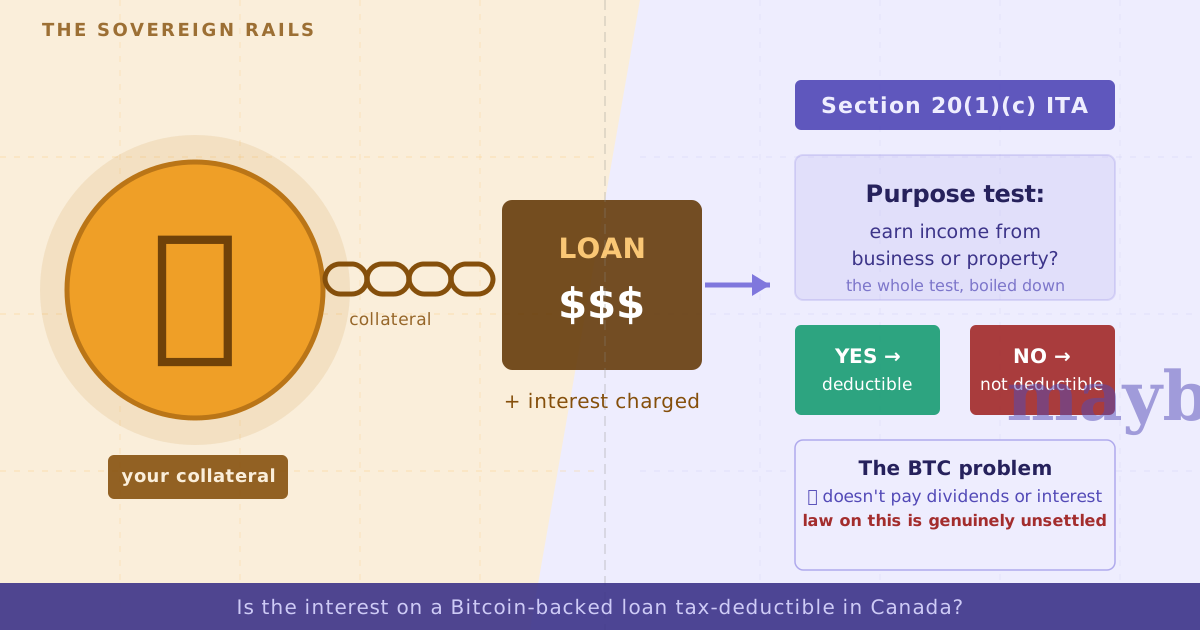
Interest deductibility in Canada lives in section 20(1)(c) of the Income Tax Act. The rule says you can deduct interest on money borrowed for the purpose of earning income from a business or property.
That's the whole test, boiled down: borrowed money + purpose of earning income = deductible interest.
Simple enough in theory. The complications come from applying it to Bitcoin specifically.
The problem with Bitcoin
Bitcoin doesn't pay income. It doesn't generate dividends, interest, or rent. It appreciates — or it doesn't — but appreciation isn't income under section 20(1)(c).
The CRA's longstanding position, confirmed in several technical interpretations, is that interest on a loan used to purchase something that only generates capital gains is not deductible. The asset has to be capable of producing income, not just appreciation.
So if you borrowed against your Bitcoin to buy more Bitcoin, the interest on that loan is almost certainly not deductible. You used borrowed money to buy an asset that produces no income. The test isn't met.
This is the part that catches a lot of people off guard. The intuition is: "I borrowed money and I'm paying interest, so it must be deductible somehow." But the purpose of the borrowing is what matters — not the fact that you're paying interest.
When it does work
The picture changes if you used the loan proceeds to buy something that actually pays income.
Say you borrowed against your Bitcoin and used the proceeds to buy MSTR preferreds — STRC, STRF, or STRD. Those securities pay dividends. Dividends are income. The purpose of the borrowing was to earn income from property. Under that set of facts, the interest on the loan has a reasonable basis for deductibility under 20(1)(c).
Or say you used the proceeds to buy a covered-call ETF that distributes monthly income. Same logic — the borrowed money went toward an income-producing asset.
The key word in all of this is purpose. What was the money actually used for? The CRA traces the borrowed dollars to their use, not to the collateral. The fact that your Bitcoin is sitting at Ledn as collateral doesn't determine deductibility — where the cash went does.
The mixed-use problem
Most people's loan books are messier than the clean examples above.
Maybe you borrowed in multiple tranches, and some of the money went to income-producing investments and some went elsewhere — living expenses, paying down other debt, buying more Bitcoin. In that case, only the portion that went toward income-earning assets is potentially deductible.
That means you need records. Loan-by-loan, dollar-by-dollar — where did each draw go? The CRA's tracing rules are strict, and "I think most of it went to investments" won't hold up if you're audited. The deductible portion has to be documented, not estimated.
I've been through this exercise with my own loan book. Six loans, different rates, different purposes. Two of them — where I can trace the proceeds directly to income-producing purchases — have a defensible interest-deduction claim. Four of them are mixed, and the deductible share is a fraction that I've calculated and documented loan by loan.
The case law backdrop
There's no CRA ruling specifically on Bitcoin-backed loans. But the general interest-deductibility framework has been worked through in the courts over many years, and the leading case is Ludco Enterprises Ltd. v. Canada (2001 SCC 62).
The Supreme Court in Ludco said the income purpose test doesn't require the income to actually materialize — what matters is whether there was a reasonable expectation of income at the time the money was borrowed. It also said the income purpose doesn't have to be the primary purpose; it just has to be a real purpose, not a sham.
That's helpful for Bitcoin-thesis investors who borrowed to buy preferred shares or dividend-paying assets: you don't have to prove the investment worked out. You have to prove the purpose was real.
The Ludco framework is what makes a 20(1)(c) claim on Bitcoin-collateralized loans defensible for the income-producing portion. It's not a guarantee — the CRA could audit and disagree, and the issue would go to Tax Court — but it's a reasonable legal position, not a stretch.
What the CRA can see
One more thing worth knowing: the CRA is paying more attention to cryptocurrency in general. T1135 reporting (foreign income verification) catches offshore holdings above $100,000. Exchanges operating in Canada report to the CRA. And if you have large loan balances showing up in your financial picture without a clear income source, it can attract questions.
Having your interest-deduction position documented — in writing, with a CPA memo, tracing each dollar of loan proceeds to its use — is the right move before your next filing. Not because a well-documented position is bulletproof, but because an undocumented position is much more vulnerable if you're ever asked to explain it.
FAQ
Can I deduct interest on a Ledn loan I used to buy Bitcoin?
Almost certainly not, under the current CRA position. Bitcoin doesn't produce income under the 20(1)(c) test. The interest on a loan used to buy Bitcoin is a balance-sheet cost, not a deductible one.
What if I used the loan for both Bitcoin and income-producing investments?
Only the portion traceable to the income-producing investments is potentially deductible. You need documentation of how the proceeds were split.
What income-producing assets make the deduction work?
Anything that generates dividends, interest, or other income — preferred shares, bonds, dividend ETFs, income-producing real estate. Capital-appreciation-only assets like Bitcoin or growth stocks without dividends don't qualify.
Do I need a CPA memo for this?
If you're claiming any deduction on a Bitcoin-backed loan, yes. The CRA's position on this area isn't fully settled, the amounts can be material, and you want a written record of your legal basis. A verbal understanding with your accountant isn't enough if you're audited.
What happens if the CRA disallows my claim?
You owe the tax on the income you would have had without the deduction, plus interest and possibly penalties. The deduction claim doesn't change what you actually owe in interest to the lender — it only affects your tax return.
The bottom line
Interest on a Bitcoin-backed loan can be deductible in Canada — but only if you can trace the borrowed money to an income-producing purpose, and only for that portion. "I borrowed against Bitcoin" doesn't get you there on its own. "I borrowed against Bitcoin and used the proceeds to buy MSTR preferreds that pay monthly dividends" gets you much closer.
Document the use of proceeds. Get a CPA memo. And treat the deduction as a bonus when it applies, not as a baseline assumption the whole strategy depends on.
That's the posture I run with my own loan book. The deduction applies to part of it. The rest of it I don't count on for tax purposes. If the CRA agrees, great. If they don't, the strategy still works.
The Sovereign Rails is a monthly letter written from inside a leveraged Bitcoin-thesis portfolio on Canadian rails. If this is the kind of thinking you're looking for, subscribe here.