
MSTR Preferreds (STRC, STRF, STRK) — How They're Taxed in a Canadian TFSA, RRSP, and Taxable Account
Operator's notes only — not financial or tax advice. This is how I think about account location in my own portfolio. Your situation will be different. Talk to a qualified Canadian tax advisor.*
Strategy's family of preferred shares — STRC, STRF, and STRK — have become serious income instruments for Canadian Bitcoin-thesis investors. Monthly distributions, yields in the 9–10% range depending on the series, and indirect BTC exposure all in one package. If you're already long MSTR or Bitcoin, these fit the thesis naturally.
The account-location question is where most Canadian investors stop thinking carefully. Where you hold these matters — not a little, but a lot.
What these instruments actually are
A quick recap before the tax treatment, because the mechanics matter.
STRC (the Strategy 9% Strike Preferred, Series A) is a variable-rate preferred share. It pays a monthly distribution based on a 9% annual target, denominated in USD, with distributions tied to Strategy's operating performance. STRF (the 10% Strike Preferred, Series A) is fixed-rate. STRK (the 8% Strike Preferred) is another variation in the family.
All three are US-listed securities. They trade on US exchanges, they pay in USD, and their distributions are classified as US-source dividends for tax purposes. That last point is the one that determines everything about where you should hold them.
The withholding tax problem
The US government withholds 15% of dividends paid to Canadian residents on US-source income — unless a tax treaty exempts it. The Canada-US tax treaty does provide an exemption, but only in specific account types.
Here's how it breaks down:
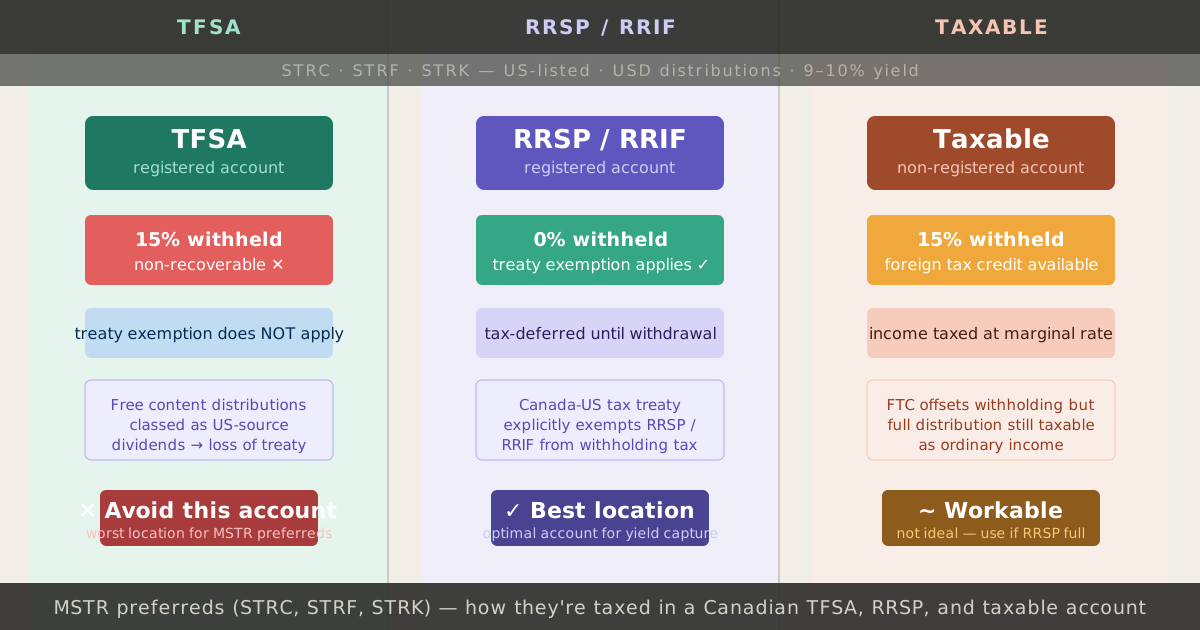
RRSP (and Spousal RRSP): The Canada-US tax treaty fully exempts RRSP accounts from US withholding tax on dividends. If you hold STRC inside your RRSP, you receive the full distribution — no 15% taken off the top.
TFSA: Despite being a "tax-free" account, TFSAs are not recognized as pension accounts under the Canada-US treaty. The US withholds 15% on every distribution, and because the income inside a TFSA isn't reportable on your Canadian tax return, there's no foreign tax credit mechanism to get it back. That 15% is gone permanently — every year, every payment.
Non-registered (taxable) account: The 15% is withheld, but you receive a foreign tax credit on your Canadian return that offsets most of it (depending on your tax situation). You don't get the money until you file, and there's a timing mismatch, but the withholding isn't lost — it reduces your Canadian tax bill dollar for dollar up to the applicable limits.
On a $100,000 STRC position yielding roughly $9,000 a year, the difference between holding in an RRSP versus a TFSA is about $1,350 per year in permanently lost withholding tax. Over ten years of compounding, that's a meaningful drag.
The RRSP complication for older investors
The RRSP looks like the obvious winner — zero withholding, tax-deferred growth. But there's a catch that matters a great deal if you're approaching your RRIF conversion age.
In Canada, you must convert your RRSP to a RRIF by the end of the year you turn 71. After that, mandatory minimum withdrawals begin — starting around 5.4% at age 72 and rising every year. All of those withdrawals are fully taxable as ordinary income.
If your income in retirement will land in the OAS clawback zone (which begins around $93,000 in individual net income for 2026), your effective marginal rate on RRIF withdrawals can reach 60-70% once you stack your personal marginal rate on top of the 15% OAS recovery tax. That inverts the usual RRSP logic for some investors.
The RRSP still wins for STRC specifically — the 15% withholding recovery is a permanent, year-after-year benefit that doesn't depend on bracket arithmetic. But the size of that benefit should be weighed against your specific RRIF timeline and income trajectory, not assumed to be automatically the right call.
One strategy that addresses the RRIF clock: a spousal RRSP, where you contribute to an account held by a younger spouse. The RRIF mandatory withdrawal timeline runs on the annuitant's age — so if your spouse is several years younger, the compounding window extends meaningfully. Distributions later taxed in the spouse's hands may also benefit from lower marginal rates and pension-income splitting.
The taxable account — worse than it looks, better than a TFSA
In a non-registered account, STRC distributions are taxable as foreign income in the year received. You report the gross distribution (before withholding), claim a foreign tax credit for the 15% withheld, and pay Canadian tax on the net.
Canadian foreign dividend income is taxed at your marginal rate — the same rate as employment income, not the preferential rate for Canadian eligible dividends. That's a meaningful distinction. A $9,000 distribution from STRC taxed as foreign income at a 45% marginal rate costs you $4,050 in Canadian tax, offset by the $1,350 foreign tax credit, for a net tax bill of $2,700. Effective rate: 30% on the gross distribution.
That's not great. But it's better than holding STRC in a TFSA, where you lose the 15% permanently and still can't deduct it anywhere. And it preserves your TFSA room for assets where the tax-free compounding story is stronger — long-duration capital-appreciation assets that generate no taxable events until you sell.
Where each preferred belongs
Working through the logic above, the account-location ranking for STRC, STRF, and STRK looks like this:
First choice: RRSP (or Spousal RRSP)
Zero withholding via treaty. Tax-deferred compounding on the full distribution. If you have room and your RRIF timeline makes the shelter worthwhile, this is where these assets belong. Spousal RRSP is worth considering if the age gap gives you a meaningfully longer compounding window.
Second choice: Non-registered margin or taxable account
You lose the time value of the withholding each year but recover it via foreign tax credit on filing. The income is taxable at marginal rates, which is the cost of holding it outside a shelter. Still better than TFSA if your RRSP room is exhausted.
Last choice: TFSA
Avoid if you can. The 15% withholding on US dividends in a TFSA is a permanent, unrecoverable cost. The TFSA's tax-free status only works on the income that reaches the account — and 15% never does. You're getting the worst of both worlds: taxable at the source, invisible on the Canadian return.
The practical question: what if I already hold these in the wrong account?
If you're holding STRC or the other preferreds in a TFSA right now, moving them isn't free. Selling inside the TFSA has no tax consequence (no capital gains in a TFSA), but if the position has a gain, you'll want to be careful about where the proceeds go and what you buy with them.
Moving positions between account types often involves selling in one account and rebuying in another. That's fine inside a TFSA (no tax event) but creates a capital gains event if you're selling from a non-registered account. An in-kind transfer to an RRSP is technically a deemed disposition — you're treated as selling at fair market value on the transfer date, which can trigger a taxable gain.
In short: repositioning is worth doing, but think through the mechanics before you act. A tax professional who knows registered accounts can walk you through the sequence that minimizes unnecessary tax events.
FAQ
Do STRC distributions count as Canadian eligible dividends?
No. They're US-source dividends, taxed as foreign income in Canada. The preferential Canadian dividend tax credit doesn't apply.
Is there any way to hold STRC in a TFSA and avoid the withholding?
No. The Canada-US tax treaty exemption for the RRSP doesn't extend to TFSAs. The withholding is hardwired by the treaty.
What's the difference between STRC, STRF, and STRK for tax purposes?
All three are treated the same way in Canada — US-source dividends subject to 15% withholding. The differences between the series are in yield, rate structure (fixed vs. variable), and conversion features — not in Canadian tax treatment.
If I hold STRC in my RRSP, do I pay tax when it distributes?
No. Inside the RRSP, distributions compound tax-deferred. You pay tax only when you withdraw — and then on the full withdrawal amount, at your marginal rate.
Does it matter which spouse holds the RRSP for STRC?
Yes, if the spouses are different ages. A spousal RRSP lets you contribute to an account your spouse owns, with the RRIF clock running on their age. If your spouse is younger, that's a longer compounding window before mandatory withdrawals kick in.
The bottom line
The MSTR preferreds are real income instruments — but where you hold them changes the after-tax yield materially. A 9% gross yield becomes a 7.65% yield in a TFSA (before Canadian tax, after permanent withholding). The same position in an RRSP delivers 9% gross to the account, with tax deferred until you withdraw.
That gap compounds. Over a decade on a meaningful position, the account-location decision is worth more than most people's attempts to optimize the underlying yield.
Get the location right first. Then figure out which series fits your income needs.
The Sovereign Rails is a monthly letter written from inside a leveraged Bitcoin-thesis portfolio on Canadian rails. If this is the kind of thinking you're looking for, subscribe here.